A free field guide to sun, heat and glare on this particular ridge — the angles the sun actually arrives at here, what each elevation does to a room, and what we would specify on it. Written for the houses that are really in Westcliff, not for a catalogue.
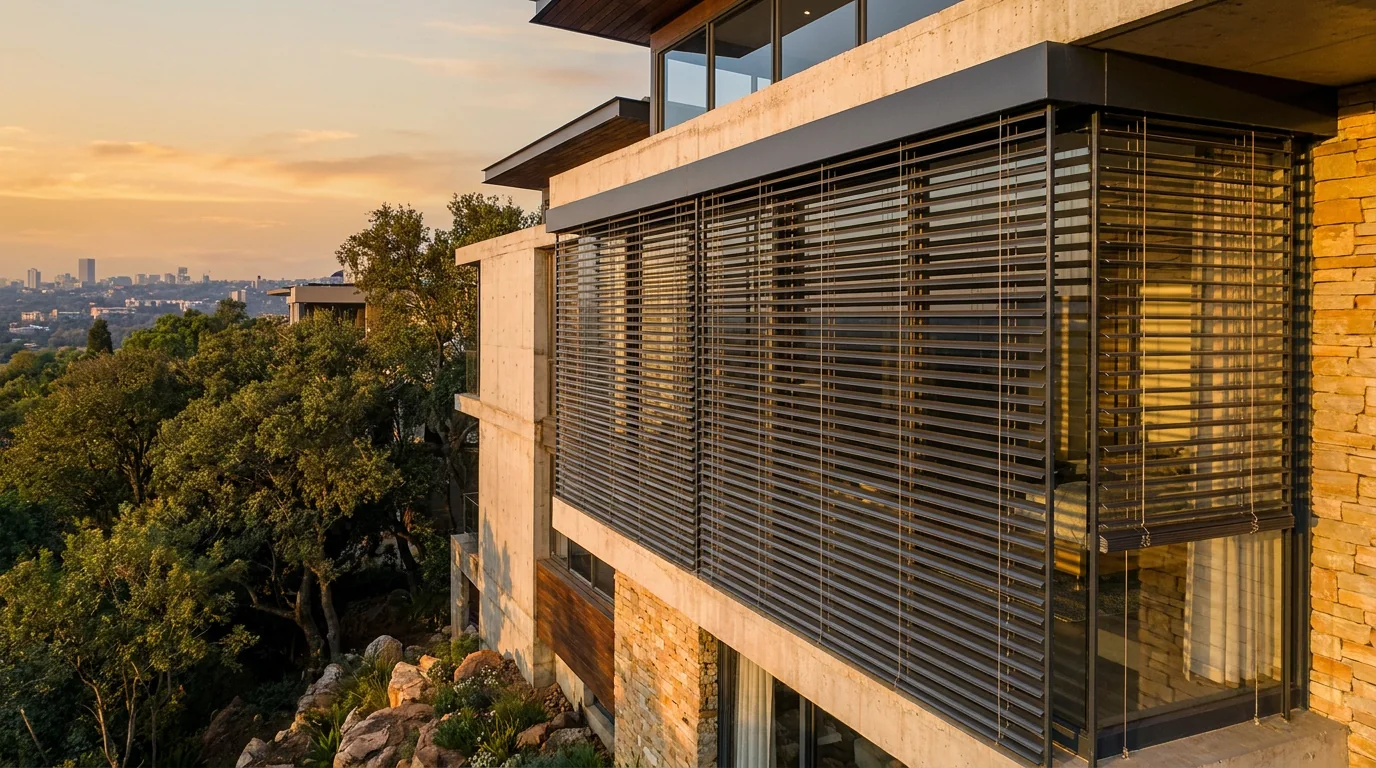
External venetian louvres on a ridge-edge elevation: the sun is stopped outside the glass, and the view is still there.
Most shading advice is written for nowhere in particular. This is written for a ridge at 26° South, 1 700 m up, where the summer sun passes almost overhead, the winter sun comes in low from the north, and the afternoon sun sets south of west with nothing in its way. Everything below is sourced.
One
Why Westcliff is its own problem
Westcliff was laid out in 1902, its roads following the natural contours of the ridge rather than a grid.2 That is why shading here cannot be done from a catalogue: on a grid you can guess a house’s orientation from its street, and on a contour road you cannot. Two neighbours can face opposite ways, and the room that bakes at four is often across the road from one that never does.
The stock is the second complication. Herbert Baker and his partners built Arts and Crafts houses here in honey-coloured quartzite cut from the koppie they stand on, and at least 100 stands sold between 1919 and 1927.2 Most of the suburb is therefore a century old: thick masonry, deep reveals, multi-pane sash joinery, no two openings identical. It wants a room-by-room answer, not a house-wide one.
Two
The light here, by season
Johannesburg sits at 26°11′ South, about 1 700 m up.1 Four numbers do most of the explaining:
Midsummer noon: the sun is 86° above the horizon — a few degrees off straight overhead.1
Midsummer the sun sets at 243° — west-south-west, not west.1
Midwinter it sets at 295°, and rises at 69°, north of east.1
The eave that shades the glass at midsummer noon does almost nothing in June. Angles from source 1.
Read practically: the summer sun is the easy one and the winter sun is the sneaky one. At 86° a deep veranda shades a north window at midday in December almost by itself — which is exactly why the old houses here have verandas that deep. At 40° in June the sun comes in under that same eave and reaches metres into the room.
Two Highveld facts then change the specification. UV rises about 10% per 1 000 m of altitude,6 and Johannesburg’s peak UV Index sits in the “extreme” band, 11 and above, for most months from September to March;7 with roughly 3 100 sunshine hours a year,8 fading is year-round. And the rain arrives as late-afternoon thunderstorms from October to March,9 hail peaking in December and January around 16:00 to 17:005 — exactly when an awning is most likely to be out.
Three
Elevation by elevation
Take a compass to each room first. Four cases.
North
Sun every day of the year
Westcliff’s own outlook: a Witwatersrand ridge described as having dramatic north-facing aspects, with views toward the Magaliesberg.2 High and manageable in summer, low and deep in winter. The mistake is over-specifying: heavy blockout throws away free July heat with the glare. North wants something adjustable through the day.
West
The expensive elevation
From about three o’clock the sun swings toward that 243° midsummer sunset and keeps dropping.1 No overhang can shade it, because the light arrives underneath — into eyes, onto floors. High on the ridge there is often nothing across the way to block it either. Heat, glare and fading land here at once.
East
Glare, not heat
The mirror image of west, but against cool overnight air and cool masonry, so it rarely becomes a heat problem. It becomes a glare problem: breakfast rooms and east bedrooms where the sun arrives before anyone is ready. Light control solves it, far more cheaply than west.
South
Calm, with a summer caveat
Even, indirect light — the right room for a desk. One caveat: the midsummer sun rises at 116° and sets at 243°, both south of the east–west line,1 so a south room catches a raking hour of low sun at each end of a December day. In June, none.
And then: upstairs
The tree canopy here — Saxonwold’s oaks and pines are the remnant of the Sachsenwald woods it is named for — does much of the summer’s work at ground level, and nothing for the first floor. Hence the comfortable ground floor and the upstairs bedroom taking the raw version.
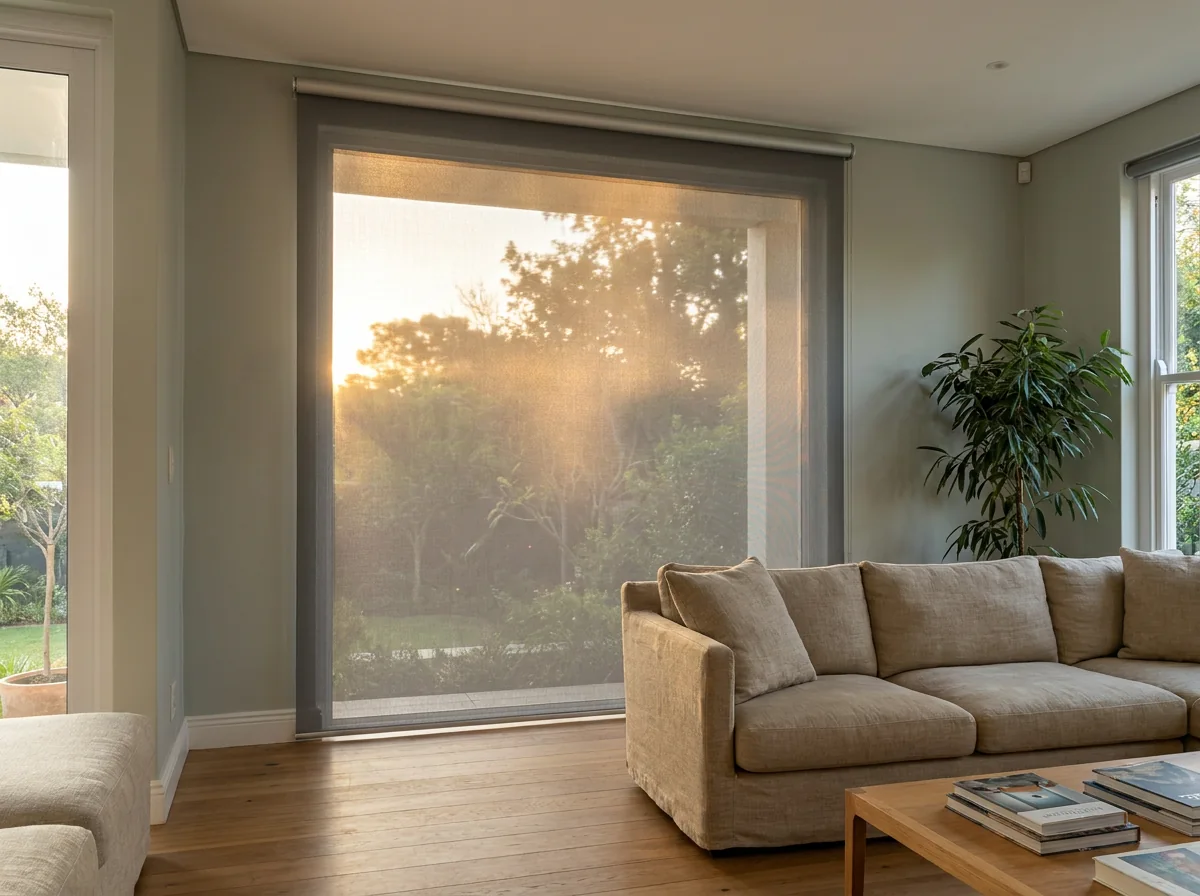
Sunscreen mesh on a west window: the glare is cut and the garden is still there. One flat sheet of open-weave fabric on a tube — openness percentage decides how much view survives.Four
What we would specify, and why
Each with its reasoning and its honest trade-off. Tick the ones that sound like your house — they carry through to the window schedule below.
For a hard west elevation
External venetians, ahead of an interior blockout roller
The physics is the argument. Louvres outside the glass stop the sun before it reaches the pane; an interior blockout absorbs that energy once it is through, so fabric and pane warm and radiate inward. The room goes dark but does not stay as cool. Louvres also keep what a roller cannot — tilt.
The trade-off, honestly: the most expensive route here, a permanent addition to the outside of the facade (see section five), and it needs a wind strategy. Where external is not possible, sunscreen mesh plus blockout on a double bracket is the honest second best — less money, meaningfully less heat control.
Where a venetian will not suit
Roller shutters — the other way to stop it outside
Aluminium slats rolling down from a headbox outside the glass. Closed, the slat curtain and the air behind it insulate as well as shade; half-lowered, it takes the top of a tall window and leaves the bottom clear. Better than louvres on a very large or high opening.
The trade-off, honestly: position, not tilt. And to be plain: these are shading shutters, for sun, heat and glare. They are not security-rated shutters — a different product, which we can quote on request.
For north-facing living rooms
Sunscreen mesh rollers, not blockout
North light is the good light; you want the sting taken out, not the light switched off. A 3–5% openness mesh cuts glare and much of the UV while the garden stays legible. Blockout behaves like a switch — so people leave it up and put up with the glare.
The trade-off, honestly: mesh gives daytime privacy only; after dark, with lamps on, it reverses and you become the lit side. Where a room needs both, a double roller answers it — mesh in front, blockout behind.
For bedrooms
Blockout rollers — the reveal matters more than the fabric
Every blockout fabric is opaque, and almost no bedroom complaint is about the fabric. It is light leaking round the edges, and a deep Baker-era reveal has a lot of edge. Inside the reveal the blind sits properly in the joinery and you accept a hairline each side; face-fixed it is far darker, but hides the reveal and the timber.
The trade-off, honestly: no free option — inside-fit for looks, face-fit for darkness, or inside-fit with side channels: darker again, one more component.
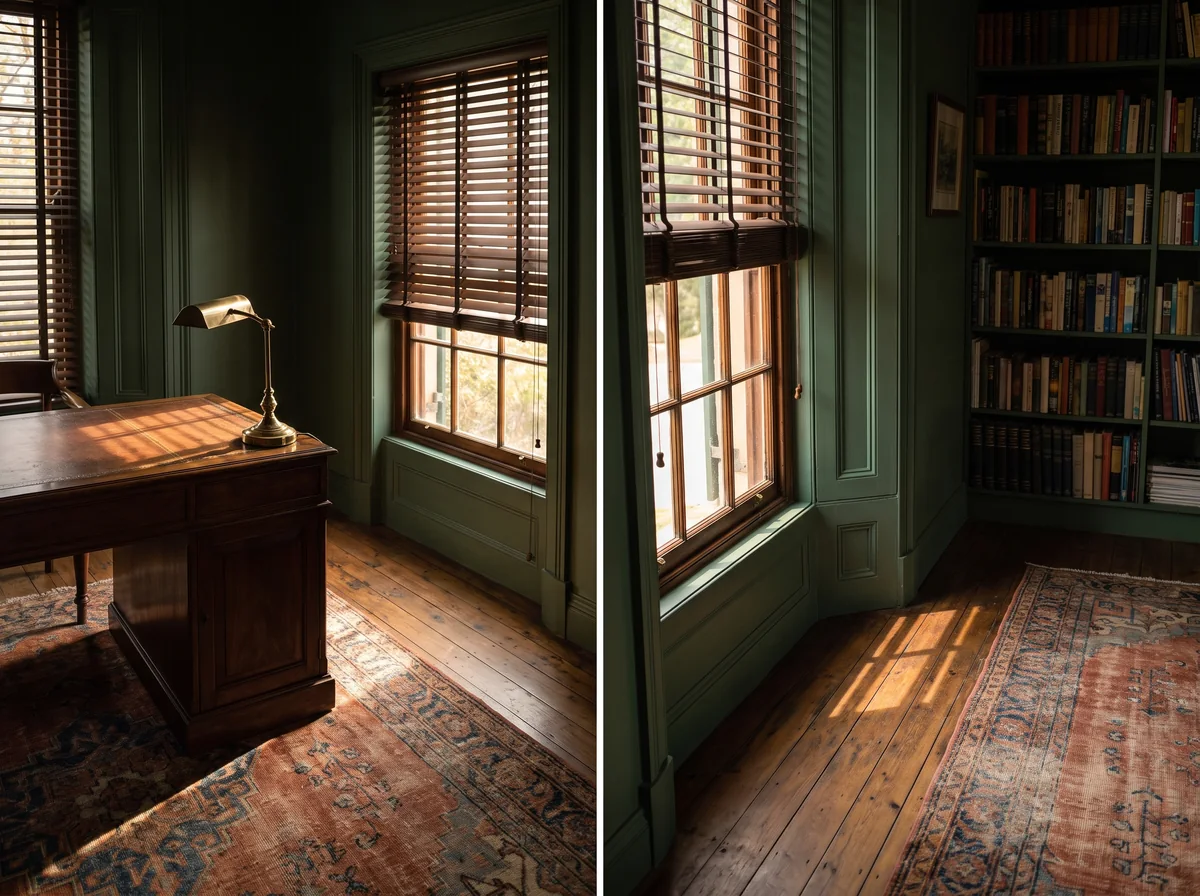
Timber slats against multi-pane sash glazing: the two rhythms read together.
For sash windows, studies and cold rooms
Timber venetians for the joinery; cellular where the room is hard to heat
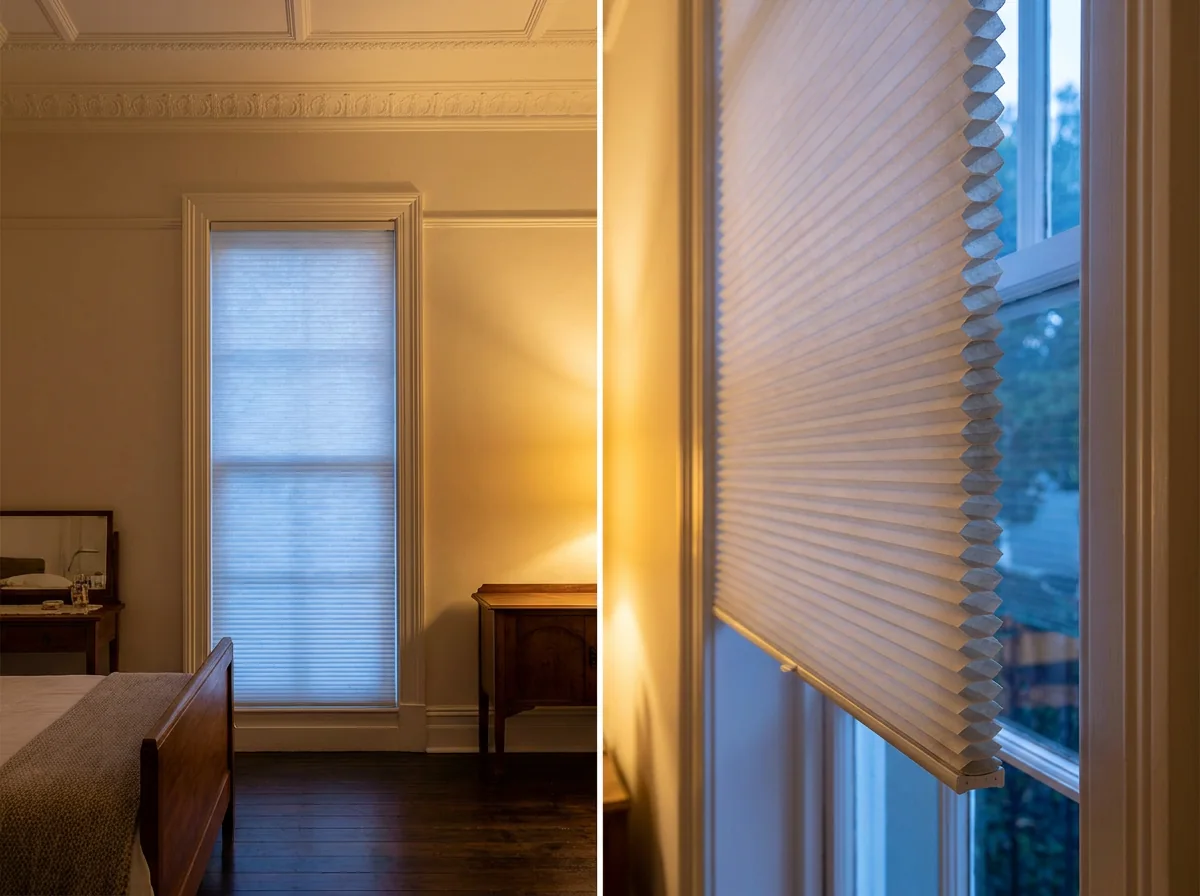
Fifty-millimetre basswood slats read at roughly the rhythm of multi-pane glazing bars, so the window still looks like the one the house was built with — and tilting them up bounces sun off the ceiling, lighting a desk without glare. Where the problem is cold instead, single glazing under a three-metre ceiling wants a cellular blind: the honeycomb traps air, and the air does the insulating.
The trade-off, honestly: timber slats collect dust and want a wipe, and past two metres wide we would split the opening or motorise it. Cellular will not take scrubbing, so kitchens and bathrooms get aluminium venetians — and cellular does not tilt.
The insulating part of a cellular blind is the air, not the fabric — the cells hold it still against the glass.
For the terrace, and across all of it
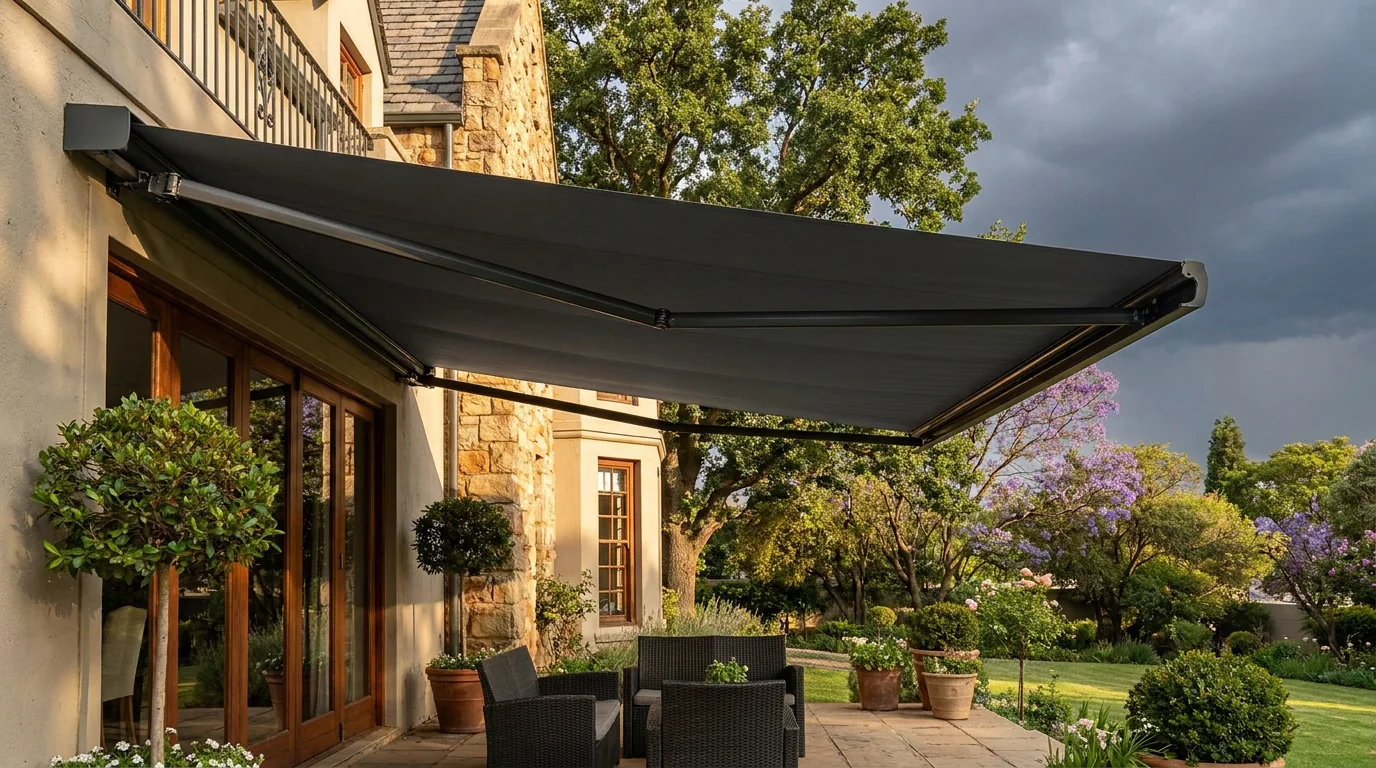
A folding-arm awning, motorised, with a wind sensor
Post-free shade that retracts suits this climate exactly: shade in January, and the 40° winter sun on the paving in July.1 A fixed roof gives the first and removes the second permanently. Motorising is the same argument one step on — and battery-tube motors mean nobody chases cable through original plaster.
The trade-off, honestly: awning fabric is a consumable, and battery tubes want charging once or twice a year. With hail peaking in the late afternoon,5 a wind sensor is not an upsell — it retracts the awning when nobody is home. On a low window rarely touched, a cord or wand is simpler and longer-lived, and we will say so.
Tell us which rooms are the problem and we will send you a copy of the Study with notes written against your elevations — which of the above we would put where, and why. It is the same guide, read for your house instead of in general.
Five
Heritage: the 60-year rule, plainly
The National Heritage Resources Act 25 of 1999 provides that no person may alter or demolish any structure or part of a structure older than 60 years without a permit from the provincial heritage resources authority — in Gauteng, PHRA-G.3 Given the 1919–1927 build-out,2 that catches most of Westcliff. Age alone does not confer heritage status: an assessment establishes it, and what you may change depends on the property’s grading.3 Locally the Westcliff Residents’ Association runs a heritage committee, and the Johannesburg Heritage Foundation — founded in 1985 as the Parktown & Westcliff Heritage Trust — is usually involved.34
Inside the reveal is a furnishing decision. Outside the glass is a building decision.
Blinds fitted inside the reveal do not alter the structure. Anything fixed to the outside of the facade — venetian guide rails, an awning cassette, a shutter headbox, zip-screen channels — is a change to part of a structure, and may need that permit.
What we can do: specify slim profiles and quiet colours, and supply the drawings and product data an application needs. What we will not do is call an approval a formality, or submit it for you.
Six
What only a site visit answers
Everything above follows from a plan and a compass. These five do not, and any one can change the recommendation:
Reveal depth, at four points. Century-old openings are rarely square, and 90 mm versus 140 mm decides whether a headbox fits inside the joinery or sits proud of it.
What is behind the plaster. Quartzite, brick, or lath and timber lintel — the substrate decides the bracket, and whether a heavy or external system is viable on that wall at all.
True orientation, room by room. On contour-following ridge roads2 you cannot read it off the street — and everything else here depends on it.
Wind exposure at your stand. A ridge-edge terrace and a sheltered courtyard on the same property behave differently, which decides awning versus zip screen.
Where the power goes. Whether a plug is within reach, whether a battery tube recharges without a ladder, whether a sensor has line of sight.
That is the honest reason the measure exists, and why it is free: better to find these out before quoting than after fitting.
Post-free shade over the stoep, retracted for the low winter sun. Note the sky: storms build late in the afternoon.
Seven
Two ways forward — pick whichever suits you
One gets you an exact answer; the other a number to think about first. Both free, neither commits you to anything.
The straight answer
Book your free expert measure
A consultant comes with samples, checks the five things in section six, measures every opening precisely and leaves you with a written, itemised, per-window quote. No charge, no obligation.
Or, to start
Rather have a number before anyone comes round?
Pop in rough sizes on the window schedule below and we will send a budget range by the next working day. Not sure how to measure? Leave it — our consultant measures for free, and you will get exact per-window pricing either way.
Plenty do both — rough sizes now, the measure after.
Westcliff Blinds — window scheduleWalk the house, fill this in, then type it in at westcliffblinds.co.za. In millimetres, and off the opening itself: width, then drop.
Your ballpark, in about two minutes
The window schedule
One line per window. Rough is fine — a tape measure and a guess at the nearest 50 mm is plenty for a budget range. Nothing here is binding, and nothing is priced off it: the real number comes from the free measure.
Your rows travel up to the free-measure form and go off with your details — we come back with a budget range by the next working day. Unsure how to measure, or would sooner not? Leave it blank and just book the free measure: the consultant measures for you, and you get exact per-window pricing instead of a range.
Nothing on this page is binding, nothing is priced from it, and nobody is going to phone you about a half-filled table. Print it, walk the house, come back to it whenever.
References
Sources
Every factual claim above about the sun path, the climate, the suburb's history and the heritage rules comes from one of these. Where two sources disagreed — the peak UV figure, for instance — we have said so rather than picking the more dramatic one.
NomadSeason — Johannesburg UV Index by month. Weather Atlas gives a lower average maximum of 12 for the same months; both put the summer months in the "extreme" band of 11 and above.
The sun-path drawing, the elevation notes and every product recommendation on this page are our own work and our own opinion, offered free and without obligation. Nothing here is a heritage-approval opinion — that properly belongs to PHRA-G and your own heritage architect.
Download a copy to share with whoever else has a say in the windows.