Home / Products
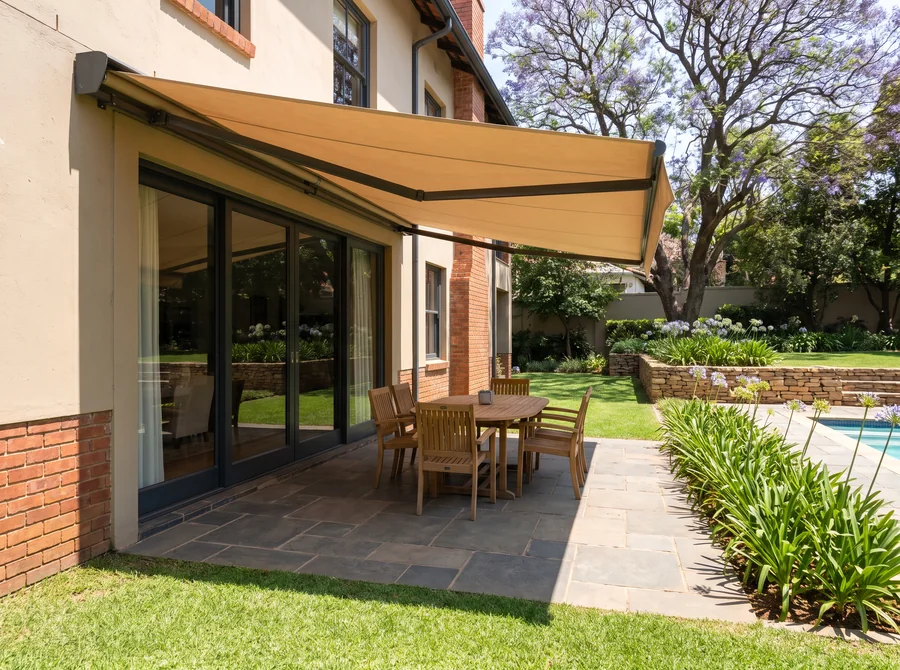
No posts, no permanent roof — a retractable awning that turns a west-facing terrace back into a room in summer, and tucks away for the winter sun.
Spring-tensioned folding arms carry the fabric out over the terrace on demand and fold back into a cassette when you don't need it — no posts interrupting the garden view, nothing in the way of a braai or a long lunch table. On Westcliff's older stoeps, that matters: an awning that doesn't require digging a footing into a hundred-year-old paved terrace is a considerably easier conversation with a heritage-minded neighbour or committee.
Motor plus wind sensor is the responsible way to fit an awning on the ridge. A Highveld thunderstorm can turn a still afternoon into a serious gust in minutes, and an awning caught fully open is the kind of damage that's entirely avoidable — the sensor retracts it automatically before the wind gets there. We'll fit a manual crank-handle version if you'd rather, but we say plainly that it's the higher-risk option.
Wind ratings are real limits, not suggestions — the sensor is what actually protects the investment.
Honestly: an awning is a shade product, not a rain product. It handles light drizzle at a pitch, never a Highveld storm cell head-on — for that, the terrace still needs somewhere dry to retreat to.
Awnings are sold by the square metre of projection — width along the wall times the reach of the arms — fitted. A crank-operated arm lands between R3,500 and R5,500 a square metre of projection; a full cassette and a long span push it up. With a motor and the wind sensor we treat as standard on the ridge, R5,500 to R7,500.
A short awning still wants full-length arms and a survey of what sits behind the fascia, so small projections carry a minimum charge. The terrace gets measured and the number written up afterwards, and that visit costs you nothing.
Stoeps and pool decks in Houghton Estate and Saxonwold's established gardens, and the newer entertaining terraces going up in Forest Town and Parktown North — every installation gets the same motor-plus-wind-sensor spec, whichever side of the ridge it sits on.
Or read The Westcliff Ridge Light Study first — free to read, nothing asked of you, and it works through the sun angles elevation by elevation.